TSN: Time Sensitive Networking
Time Sensitive Networking (TSN) is a technology that combines the large bandwidth capabilities of Ethernet with the determinism of a real-time fieldbus – all based on vendor-neutral standards specified by the IEEE 802.
Explore How Automation Networks Are Changing
The incredible progress in machine intelligence and robotics in recent years has driven progress in automation, especially industrial automation and automotive control.
TSN offers many benefits to modern industrial automation networks by providing high bandwidth and reliable, dependable real-time communication.
TSN can be leveraged for a variety of applications not only because of the technological advantages but also because of its lower total cost of ownership (TCO). You may have the added cost of replacing existing switches with TSN switches, but that typically costs less than duplicating networks and maintaining the additional networks.
In automation networks, TSN enables the convergence of numerous small, disconnected networks into one unified network structure. This new network can accommodate the requirements for real-time communication on a larger scale, while providing more transmission bandwidth for background data. Have a look at some use cases showing the benefits of network convergence in different markets.
Belden is committed to furthering the TSN technology and deliver Industrial Ethernet switches with the highest possible quality standards. Explore our continuously expanding portfolio of TSN capable devices and software solutions ensuring reliable vendor independent communication.
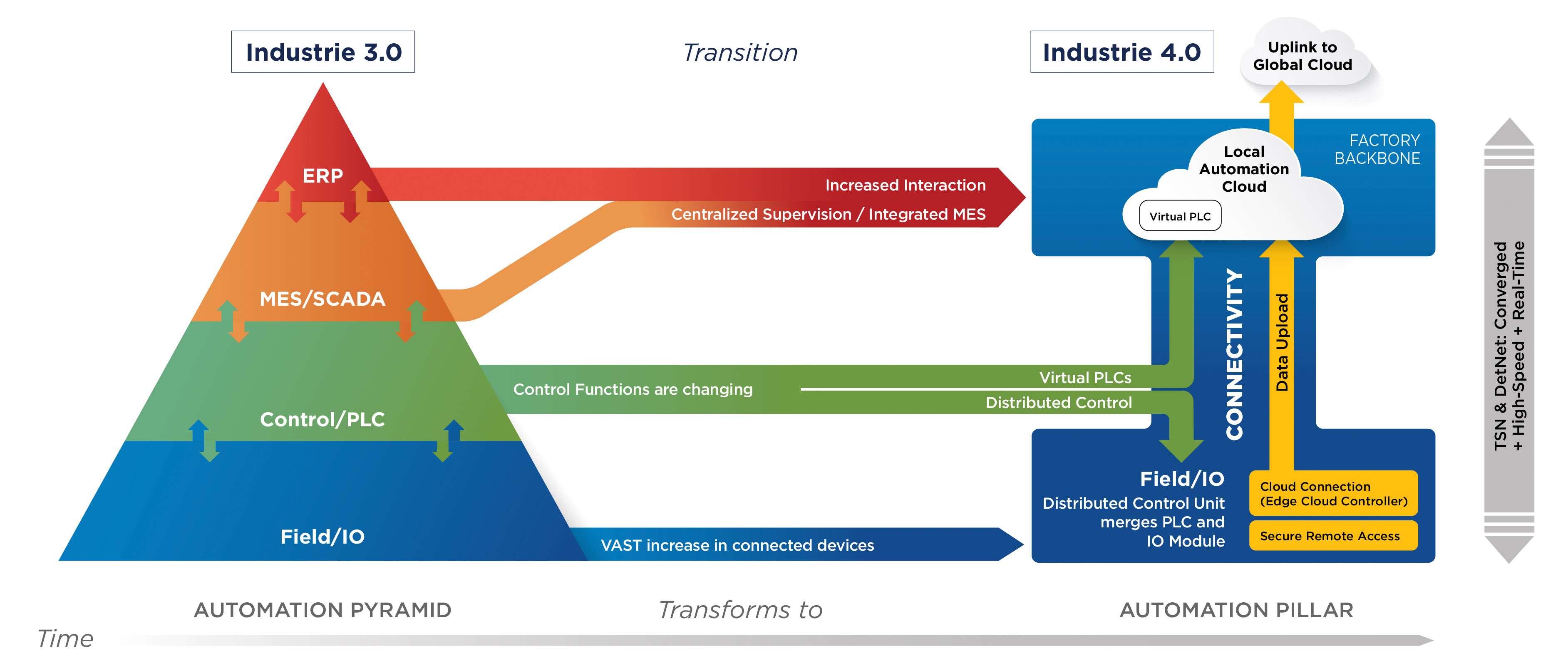
Industrial automation markets are driven by the transition from Industry 3.0 to Industry 4.0. or the smart factory, one part of the Industrial Internet of Things (IIoT). This transition is commonly illustrated as a shift from the automation pyramid to the automation pillar.
The Transformation of Industrial Automation
Industrial automation markets are driven by the transition from Industry 3.0 to Industry 4.0. or the smart factory, one part of the Industrial Internet of Things (IIoT). This transition is commonly illustrated as a shift from the automation pyramid to the automation pillar.
The pyramid model, which industries have followed for several decades, strictly separates functional layers from the factory shop floor (the field level) up to the management systems at the top. Real time data communication is usually at the field level, where sensors and actuators are located, and between the field and controller levels.
The automation pillar in an IIoT (Industrie 4.0) production environment still has a field level on the factory shop floor, but the total number of sensors on the field level is drastically higher to allow a much tighter analysis and control of the manufacturing functions.
In the automation pillar, the controller level disappears. Some of the control functions move to the field level as distributed control units, which are used for extremely fast and reliable reactions, such as for safety functions. Other control units move into the management level (factory backbone) as centralized control units (“Virtual PLC”).
Virtual control functions or virtual programmable logic controllers (PLCs), hosted in the local automation cloud, interact directly with the production process through the connectivity layer. Virtualization of the PLCs provides maximum flexibility; they can be added and removed, and computing power can be allocated to wherever it’s needed most. Applications in the factory backbone don’t even need to be located physically close to the field-level applications. They can be located anywhere: in the IT department or even in a data center far from the factory, depending on the maximum end-to-end latency (delay) the applications allow. This flexibility in the control processes translates into flexibility in the production process.
Between the field level and factory backbone is a connectivity level. Both the field level and the connectivity level require high-speed, low-latency network performance. In addition, the connectivity layer carries lower-priority background traffic in a way that must not slow down the time-critical traffic. This is where TSN comes in.
TSN Future-Proof Ethernet Networks
TSN takes IEEE* 802 Ethernet to the next level to address the requirements from today’s and future automation networks. TSN offers unprecedented low end-to-end latency, as well as frame delivery precision with very low jitter that goes beyond anything that was ever possible with standardized IEEE 802.1 technology. Standardization in IEEE 802.1 and IEEE 802.3 ensures interoperability between different vendors, a broad market scope, scalability with future Ethernet speed increases and investment security.
* Institute of Electrical and Electronics Engineers
Since the establishment of the Field Level Communications (FLC) initiative in the OPC Foundation in November 2018, it has been clear: The technology combination of OPC UA and IEEE TSN as a vendor-neutral communication technology enjoys broad support not only on paper, but also in technical implementation. Belden has supported this development from the very beginning.
TSN Resources
Although it offers advantages, implementing time-sensitive networking (TSN) can present challenges. Taking a phased approach to TSN deployment creates results.
Find out how different levels of 5G integration align with industrial automation’s need for high reliability and ultra-low latency—and what’s possible today.
Industrial automation will benefit from 5G-TSN integration—once 5G can support time-sensitive networking. Learn about obstacles the industry must overcome before 5G-TSN integration becomes reality.
Integrating 5G and TSN could be a critical step toward establishing more fully connected and productive industrial environments.
Learn how TSN can help you realize more flexible, intelligent and dynamic production facilities
Digital technology has taken over many aspects of our lives and the factory floor is no different. Thanks to Industry 4.0 (also referred to as the “smart factory”), digital technology has become a priority for the manufacturing industry over the...
Progressive TSN Deployment: For Success, Lead with the Network
Although it offers advantages, implementing time-sensitive networking (TSN) can present challenges. Taking a phased approach to TSN deployment creates results.
What OT Environments Can Capture from 5G Integration Today
Find out how different levels of 5G integration align with industrial automation’s need for high reliability and ultra-low latency—and what’s possible today.
3 Problems to Solve Before Plants Can Benefit from 5G-TSN Integration
Industrial automation will benefit from 5G-TSN integration—once 5G can support time-sensitive networking. Learn about obstacles the industry must overcome before 5G-TSN integration becomes reality.

5G and TSN: Working Together to Meet Real-Time Requirements
Integrating 5G and TSN could be a critical step toward establishing more fully connected and productive industrial environments.
Time-Sensitive Networking (TSN) White Paper
Learn how TSN can help you realize more flexible, intelligent and dynamic production facilities

Changing the Face of Automation with TSN
Digital technology has taken over many aspects of our lives and the factory floor is no different. Thanks to Industry 4.0 (also referred to as the “smart factory”), digital technology has become a priority for the manufacturing industry over the...
What Can TSN Do For You?
By now, most industrial network operators have heard about Time-Sensitive Networking, or TSN. We get a lot of questions from customers about its status and how it can benefit their operation. As someone who works as an editor for several TSN...
Future-Proof Now: How the Next Generation of Switches are Meeting TSN Network Demands
As many readers know, Belden is no stranger to the world of compact managed switches, and we’re proud of the fact that network operators have made the company the market leader with more than 700,000 units in active operation worldwide.